
Bots and buyers alike are bypassing the parts of the funnel you’ve always optimized for. So why are you still starving brand to feed demand?
Most B2B companies spend 80% of their marketing budget on the last 10% of the buyer’s journey.
There’s only three things you’re guaranteed in life: death, taxes, and that if you ask any CFO about investing more in marketing, and they will immediately ask about ROI.
As a result, many marketers have spent the last decade putting money into the tactics and channels they can defend against their CFO’s narrow definition of “return on investment.” They’ve been pouring money into paid search, outbound, and bottom-of-funnel conversion campaigns that attribution models “prove” work, treating brand at best like a nice shade of lipstick they slap on before they hit the tradeshow floor.
Meanwhile, buyers have quietly moved the entire evaluation process into AI. Before a prospect ever fills out a form, books a demo, or speaks to a single human on your payroll, they have already used AI to research their problem, compare options, filter out the noise, and create a solution shortlist – all without visiting a single vendor website.
Today, B2B marketers face a monster with two heads:
Buyers are skipping the funnel you’ve spent millions optimizing
They’re not clicking your paid search ads, filling out forms, entering your 12-touch nurture sequences, or letting an SDR “educate” them on your category during a discovery call. They’re skipping over all of those touchpoints in favor of an AI shortlist.AI can’t see the content inside gated assets
Those high-value guides, ROI calculators, whitepapers, and case studies locked behind form fills don’t exist to the LLMs summarizing your category.
As Harvard Business School professor David Edelman recently explained, this monster is why brand strategy has suddenly become marketing’s most urgent AI problem. Where most marketers have been investing in demand, brand now rules the roost when it comes to AI search.
What is a brand, anyway?
There is an old adage that people make decisions based on feelings, and back them up with data – not the other way around. After all, even for data-driven people like CFOs, every major software or services purchase still carries personal risk. Nobody wants to look stupid in front of their board, blow six figures on shelfware, or stake their reputation on a vendor that overpromises and disappears after kickoff.

When your traditional demand engine becomes invisible, your brand has to do all the talking
According to AirOps 2026 State of AI Search report, 85% of brand mentions in AI-generated answers originate from third-party sources rather than vendor sites. That means that more than ever before, your brand isn’t what’s in your brand guidelines, it’s what people feel and say about you when you’re not in the room.
In the age of AI, your brand has to deliver for AI search in addition to the buyers who make the final call. You need to deliver for two different audiences:
People, who want to understand your point of view, talk to your team, and experience your product. They want to know you understand their world, and they want to understand how you’re different from every other vendor in your category. They want to hear from people like them who’ve had success with your solution and a great experience working with your company.
AI, which synthesizes the essence of your brand from real customer experiences, analyst reports, peer conversations, and third-party proof. It takes your word for who you are just 15% of the time, relying on how others see you to inform if it places your solution on a shortlist or not.
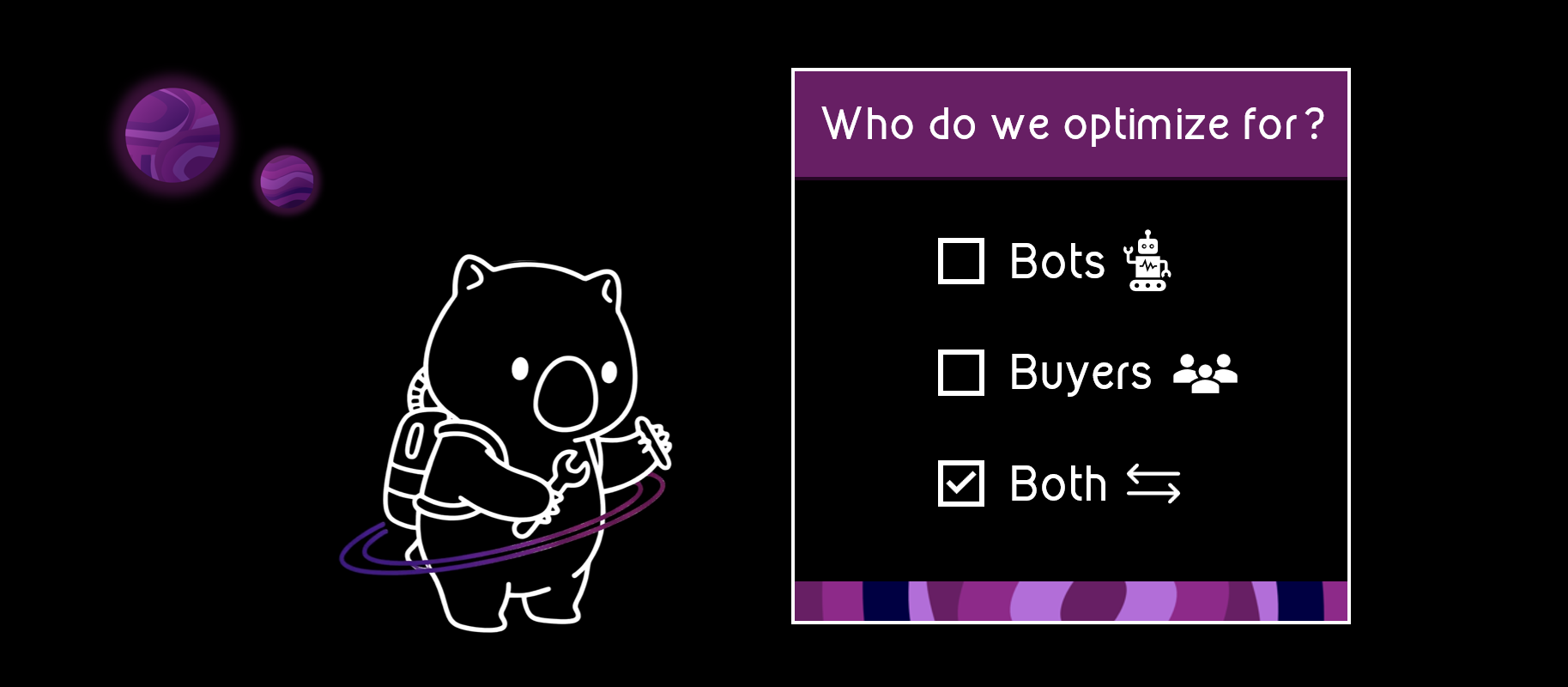
So who do you optimize brand for now: bots, buyers, or both?
This is the question tripping up every B2B marketing leader right now: do you optimize your brand for the bots building the shortlist, or the human buyers signing the check?
Here is the trap: most marketers have spent years optimizing their brand for buyers. They assume the next phase of evolution needs to focus on making their brand AI-friendly. They focus on the channels they control, cranking out soulless, keyword-stuffed slop content, deploying uncanny-valley AI creative, and letting generative tools flatten their voice into beige corporate mush.
When you over-rotate into optimizing for bots, you risk having a real human buyer land on your site, smell the robotic copy a mile away, and bounce in five seconds flat. Conversely, if you write purely for humans with clever brand storytelling, zero structured proof, and all your best ROI data locked behind lead-gen gates, AI can’t find you, and you won't even make the buyer’s shortlist.

The one thing people and AI have in common? The need to see proof.
AI builds its impression of your brand from third-party sites: analyst reports, peer reviews, customer testimonials, Reddit forums, and more. It synthesizes thousands of inputs into a single output, drawing on third-party proof points to verify the 15% of information it pulls from your channels. For AI, customer proof is the validation layer through which it assesses your claims.
But human buyers also crave validation from their peers before making a decision.
According to HG Insights, even in the age of AI, 74% of B2B buyers consult customer reviews during their purchase journey, with 53% speaking directly to a peer about their experience. What’s more, while buyers are using AI to do research, they’re skeptical of its claims, with 94% of buyers reporting that they needed to fact-check AI-generated information.
At the top of the new funnel, AI validates your marketing claims using customer proof points. In the next stage, human buyers validate AI’s claims about top vendors using customer proof points.
And with 26% of stalled B2B deals failing due to unproven ROI or a lack of clear differentiation, the need for proof points extends throughout the sales funnel – even the new AI-accelerated version.
For marketers, customer value is the new secret to success at every stage
To win at every stage of this new buyer’s journey, you need to relentlessly focus on customer value. You can’t please both people and AI by cranking out robotic LLM-bait or starving brand to feed a dying demand engine. You win when the foundation of your brand is in human conviction and provable, measurable customer value.

The secret is to anchor your brand in real human experiences, then package those proof points so machines can verify them. By doing so, you unlock a brand strategy that goes beyond a mood board to create a decision filter that survives both human and machine scrutiny.
Optimize for buyers with voice, spine, and emotion
Give humans a sharp point of view that challenges the status quo, acknowledges their career risk, and speaks their language, from the daily practitioner to the CFO. Back up marketing claims with customer proof points that show you understand your space, their role, and their risk.Optimize for bots with structure, receipts, and open access
Take your best customer outcomes out from behind lead forms. Publish concrete, structured proof – specific financial metrics, clear use-case boundaries, and independent third-party validation – so LLMs can confidently cite why you win.
You cannot trick an LLM into recommending a brand or product that humans hate, and you cannot charm a buyer who never discovers you. When you lead with human conviction and back it up with machine-readable receipts, you don't have to choose.
How to prove brand payback to your CFO (without getting laughed out of the boardroom)
Now for the hard part. If you’re a marketer reading this, you’re probably thinking, "great, Sarah. Now you try explaining 'emotional resonance and AI curation' to my CFO when they want pipeline attribution by Friday."
Here is the mistake most marketing leaders make: they pitch brand to Finance using marketing metrics like impressions, share of voice, "brand lift.” But CFOs don't fund awareness; they fund margin, capital efficiency, and predictable revenue. And with brand now doing 90% of the heavy lifting before a buyer ever enters your pipeline, continuing to starve brand to feed demand won’t move the needle.
Ready to speak the language of the CFO? Link brand impact to the P&L.
It multiplies marketing efficiency
Research from Les Binet, Peter Field, and LinkedIn’s B2B Institute shows that campaigns driving brand metrics deliver 4x the bottom-line business impact of performance-only campaigns, and make short-term demand generation 50% more likely to convert. According to research from Forrester, companies with high brand equity drive 20–40% lower CAC through increased organic and AI-driven discovery.It drives win rates, deal velocity, and pricing power
Forrester’s B2B Brand Survey found that 41% of buyers already have a single preferred vendor in mind before they start researching, and over 90% lock in a shortlist before showing any buying intent. Companies with high brand equity see 20–40% higher shortlist inclusion and 10–20% pricing premiums (climbing to 40–60% in enterprise tech).It’s good for margin, too
McKinsey’s B2B branding research confirms strong brands consistently outperform peers on EBITA margin, even when they increase brand spend to support their initiatives.
The message you need to convey is that the real risk isn’t investing in brand. It’s starving your brand to feed short-term paid channels – or ruining it with cheap, soulless AI slop – and watching your CAC skyrocket because neither humans nor algorithms have a reason to trust you.
The bottom line for marketers
AI didn't kill brand strategy. Instead, it handed brand 90% of the buyer’s journey and stripped away all the places weak brands used to hide.
You can no longer buy your way out of blurry positioning, and you can’t game an algorithm with robotic copy that turns off real human buyers. The brands that win over the next five years won't be the ones churning out the most AI-generated noise. They’ll be the ones that place their bets on unmistakable human conviction paired with a single, undeniable operational truth: quantifiable customer value.
Build a brand that resonates with real people, back it up with financial receipts that both humans and AI can verify, and watch what happens when the market starts doing the talking.
Ready to win the 90% of the buyer’s journey you can’t see?
At Centric Advisory, we help B2B revenue, marketing, and product leaders replace fluffy positioning with a unified, value-first GTM architecture that earns human trust, wins AI shortlists, and holds up all the way to the CFO’s sign-off. Explore our approach or book a conversation with our team to turn measurable customer value into your sharpest competitive edge.
