
Why the C-suite is where good deals go to die, and how level-ready messaging can bring them back to life.

It happens every single day in B2B SaaS. Your rep picks up an inbound demo request from an eager junior-level specialist at one of their target accounts. The rep runs a killer discovery call, nails the product walkthrough, and ends with a great testimonial from one of your customers. Your value prop lands perfectly, and your product capabilities make the specialist’s eyes light up. They tell you they need to get started ASAP.
Then the deal goes upstairs to get signed, and it flatlines.
Why?
Because while your messaging spoke fluent specialist, the person holding the budget only speaks boardroom.
If you want to close enterprise deals in a market where every dollar is scrutinized, you don't just need good positioning. You need level-ready messaging: a cohesive narrative architecture where every single persona - from the individual contributor to the CEO - gets a pitch tailored to their specific KPIs, without losing sight of your company’s core value proposition.

The inbound trap: why your funnel is full of specialists in the first place
Here is an uncomfortable truth about B2B go-to-market: C-suite leaders do not fill out "request a demo" forms. I know this for a fact – after all, I am one.
For example, when a company is looking for a new martech solution, the CMO (that’s me!) isn’t browsing G2 or downloading whitepapers. To be honest, 90% of the time, I don’t even know it’s happening. My subject matter experts, specialists, and managers do the research. They look on Reddit for recommendations, they look at reviews on G2 or Capterra, they ask AI to build a shortlist of vendors. If you make the cut for consideration, they are going to be the ones who are hitting your website, entering your funnel, and taking that initial discovery call.
That means your sales team almost never starts at the top. They start at the bottom of the org chart and have to claw their way up the chain to find – and build a business case for – the actual economic buyer.
If your sales playbook doesn't give your team a way to translate your value prop from the person who uses the tool to the person who pays for it, your pipeline is going to stay permanently stuck in middle management. You might luck out with a manager who owns enough budget to fund your solution, or even with a marketing exec who can connect the dots themselves, but otherwise, you’re out of luck – and out of consideration for the next budget cycle.
Deconstructing the funnel: the math behind level-ready messaging
To see how this works in the real world, we first have to unpack how your buyers measure success.
Imagine you are an enterprise martech vendor selling SEO tools. You learn that your top prospect has an aggressive growth mandate this year: $10M in net-new ARR.
On paper, that $10M ARR is one single goal. Inside the organization, however, that goal translates into five completely different realities depending on what level you are talking to.
1. The CEO & CMO: the revenue mandate
Their goal: $10M in net-new business. No surprises.
What they care about: market share, customer acquisition cost (CAC), managing board expectations, and hitting the number that their bonuses – and jobs – often depend on.
What they do not care about: pretty much anything in your current pitch. Domain authority, backlink profile, search volume – they probably don’t know what these terms mean.
2. The VP of Marketing: the pipeline multiplier
Their goal: generate $50M in qualified pipeline.
The math: the VP of Marketing knows that the company’s current win rate is 20%. That means, to hit $10M in closed-won revenue this year, the sales team needs 5x pipeline coverage - $50M in pipeline. At a $100K average contract value (ACV), that means their team needs to deliver 500 qualified opportunities to the sales team.
What they care about: predictable pipeline generation, conversion efficiency, and proving marketing's direct contribution to revenue.
3. The Director of Demand Generation: the conversion engine
Their goal: generate 835 demo requests.
The math: the Director of Demand Gen knows that only 60% of demo requests that come in through the website actually convert to a qualified sales opportunity. That means the Demand Gen team needs generate 835 demo requests to meet the VP's 500-opportunity target.
What they care about: lead quality, funnel velocity, and squeezing more demos out of existing channels without blowing up paid acquisition spend.
4. The Digital Marketing Manager: the traffic driver
Their goal: 42,000 website visitors.
The math: the Digital Marketing Manager knows their current website-to-demo-request conversion rate hovers right around 2%. To hit 835 demo requests at a 2% conversion rate, the Digital Marketing team needs to drive 42,000 qualified visitors to high-converting pages.
What they care about: organic traffic growth, bounce rates, landing page optimization, and channel attribution.
5. The SEO Specialist: the reach architect
Their goal: 20% improvement in the number of high-intent keywords where the company appears in Google’s top 3 results
The math: in this organization, non-branded organic search is the highest-converting, most cost-effective driver of qualified web traffic. Getting the site to show up more frequently in the top 3 positions in Google means more clicks and more traffic to support their manager’s goal.
What they care about: keyword rankings, technical site health, content optimization, content creation velocity, and competitor SEO performance.

Where deals go to die: the translation function
Look at that chain of cascading goals again: more top 3 keywords → more traffic → more demos → more opportunities → more pipeline → more revenue.
Now compare that with how most B2B sales teams actually sell.
The demo request comes in. The SDR books a meeting with the SEO Specialist. The AE runs a great demo showing how the platform automates technical audits and helps rank get more keywords to rank faster. The SEO Specialist brings in the Digital Marketing Manager, who gets excited about scaling traffic.
Then, the AE gets a chance to pitch the VP of Marketing – and uses the exact same deck.
The AE proudly announces, "our platform can help your team scale organic traffic by 40%!" The VP nods politely, says they’ll think about it, and ghosts the rep.
So what happened?
After all, the AE followed your playbook to the letter. They moved up in the organization, they explained your value prop, and they even used real customer proof points to demonstrate your solution’s impact. The problem is, your playbook wasn’t designed for the economic buyer. Your playbook – and your rep – forgot that not every buyer speaks the language of SERP analysis and website visitor growth.
After all, the VP doesn't have a traffic quota. They have a $50M pipeline quota. And their boss, the CMO? They have a $10M revenue target to hit. Neither one wakes up in the morning thinking about Google rankings and website visitors. They want pipeline growth, predictable forecasts, and on-target results.
How to build level-ready messaging that ladders up
The missing link in your playbook is level-ready messaging: a narrative ladder that keeps your core value proposition at the center, while the proof points and hooks shift dynamically based on the buyer's altitude.

For example, here is how that same SEO martech vendor could use level-ready messaging to reframe the exact same capability across all five levels of buyer conversation:
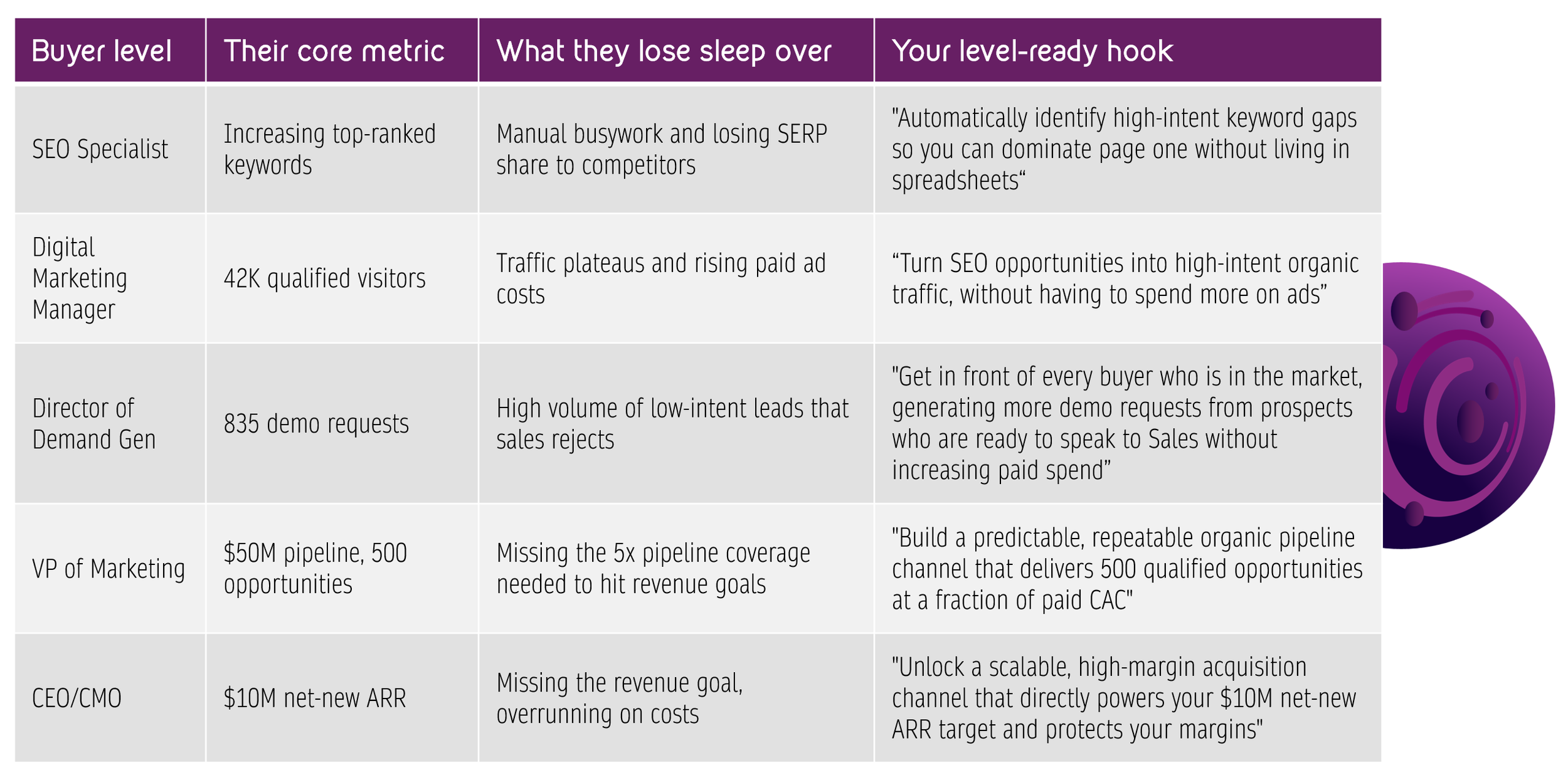
Operationalizing the ladder
You can’t fix a messaging problem with a one-off enablement session. Instead, you need to embed the ability to altitude shift into every part of your go-to-market motion.
Audit your inbound discovery.
Stop letting reps treat specialist calls like the finish line. Train them to use early discovery to uncover the upstream math. If a manager says they need more traffic, the rep's next question should be, "and how many demo requests is that traffic supposed to generate this quarter?"Build multi-threaded business cases.
Never hand a champion a generic one-pager and hope they can sell it upstairs. Arm your specialist or manager with a C-suite business case that translates their tactical wins directly into the VP’s pipeline math and the CEO’s growth goal.Align marketing and sales around the same hierarchy.
Your product marketing team shouldn't just be writing persona decks in a vacuum. Your website copy, outbound sequences, and sales decks should mirror the exact same ladder that hooks the researcher at the bottom while building the financial argument for the executive at the top.1.

When your messaging is truly level-ready, every conversation moves a deal closer to closed-won. You meet the practitioner where they live, validate their daily grind, and seamlessly elevate the conversation to the numbers that actually sign the check.
Can your messaging survive the trip up the org chart?
If your sales team is crushing discovery calls with managers only to get ghosted by the economic buyer, you don't have a product problem—you have a translation problem. At Centric Advisory, we help B2B SaaS leaders architect level-ready positioning and go-to-market playbooks that speak fluent boardroom.
